A 3-Stage Treatment Roadmap
Towards Complete Remission
A systematic journey from symptom improvement to normalization of inflammatory markers and endoscopic recovery.
Treatment proceeds in three stages
Clinical
Remission
Normalization of
Inflammatory Markers
Endoscopic
Remission
Clinical Remission
Many people wonder if ulcerative colitis or Crohn's disease can truly be treated with Korean medicine, and how long the treatment takes. The overall treatment period varies depending on the patient. However, this does not mean that treatment will proceed indefinitely without a plan.
At HanStep Korean Medicine Clinic, we aim for the initial symptoms to improve by more than 50% within the 'first 3 months of treatment'. If the root cause is precisely treated from the beginning, most patients experience more than a 50% improvement in symptoms within 3 months.
The total treatment duration depends on how many underlying causes the patient has.
When there is one cause
As mentioned in the 'Classification of Korean Medical Causes' section, ulcerative colitis and Crohn's disease are not diseases with a single cause. Occasionally, about 10% of patients have a single cause, and in such cases, treatment can be completed from start to finish with just one prescription.
In these cases, treatment is easy and proceeds smoothly without worsening during the process, making the patient feel comfortable and shortening the treatment period. If there is only one cause, the entire treatment can be concluded with endoscopic remission achieved within 6 to 8 months.
When there are two or more causes (Most patients)
This applies to patients who have two or more of the 6 causes: digestive type, inflammatory type, respiratory type, abdominal cold type, edema type, etc. In these cases, treatment is carried out by eliminating the causes one by one.
For example, let's consider a case where three causes overlap: the digestive type with upper gastrointestinal issues, the inflammatory type where symptoms worsen after eating spicy food, and the respiratory type with a tendency to feel cold or having rhinitis.
* The process of symptoms improving in stages as each cause is resolved
Treatment of the first cause
Example: Treating the digestive type
If the most prominent cause at the beginning is a digestive problem, we treat that first. Once digestive treatment begins, symptoms like diarrhea, bloody stools, mucus, and abdominal pain start to decrease, leading to more than 50% improvement within 2-3 months.
Temporary worsening and prescription change
Example: The emergence of a hidden second cause
Once the digestive issues are almost resolved, the second cause, which was hidden behind the first, begins to surface, and at this time, symptoms may worsen. Bloody stools that had disappeared may return, diarrhea frequency may increase, or calprotectin levels may rise. The symptoms show a course of improving and then worsening, which is a necessary process to go through during treatment. Upon examination, we can confirm that the digestive issue has not worsened like it was at the beginning. At this time, the prescription should be changed appropriately to respond.
Sequential prescription changes and clinical remission
Example: Inflammatory type prescription, etc.
If symptoms worsen again as a third cause emerges after the respiratory and rhinitis issues are fully treated, this indicates it is the inflammatory type. Therefore, we use three types of prescriptions for the inflammatory type in order, and by using the one that best suits the patient, bloody stools and diarrhea disappear again, and inflammatory markers return to completely normal levels. As a result, treatment is conducted by sequentially changing prescriptions according to the causes. Since the causes are not infinite, improvement will eventually occur.
By treating with the know-how accumulated at HanStep Korean Medicine Clinic since 2007, we achieve the first goal: clinical remission. Once clinical remission is achieved, the main symptoms of ulcerative colitis and Crohn's disease—such as abdominal pain, diarrhea, bloody stools, and mucus—improve. At the same time, indigestion, heartburn, reflux esophagitis, hypersensitivity to cold food, rhinitis, and cold hands/feet all improve, and the patient returns to a state clinically equivalent to that of a healthy person.
Normalization of Inflammatory Markers
(Blood & Stool Tests)
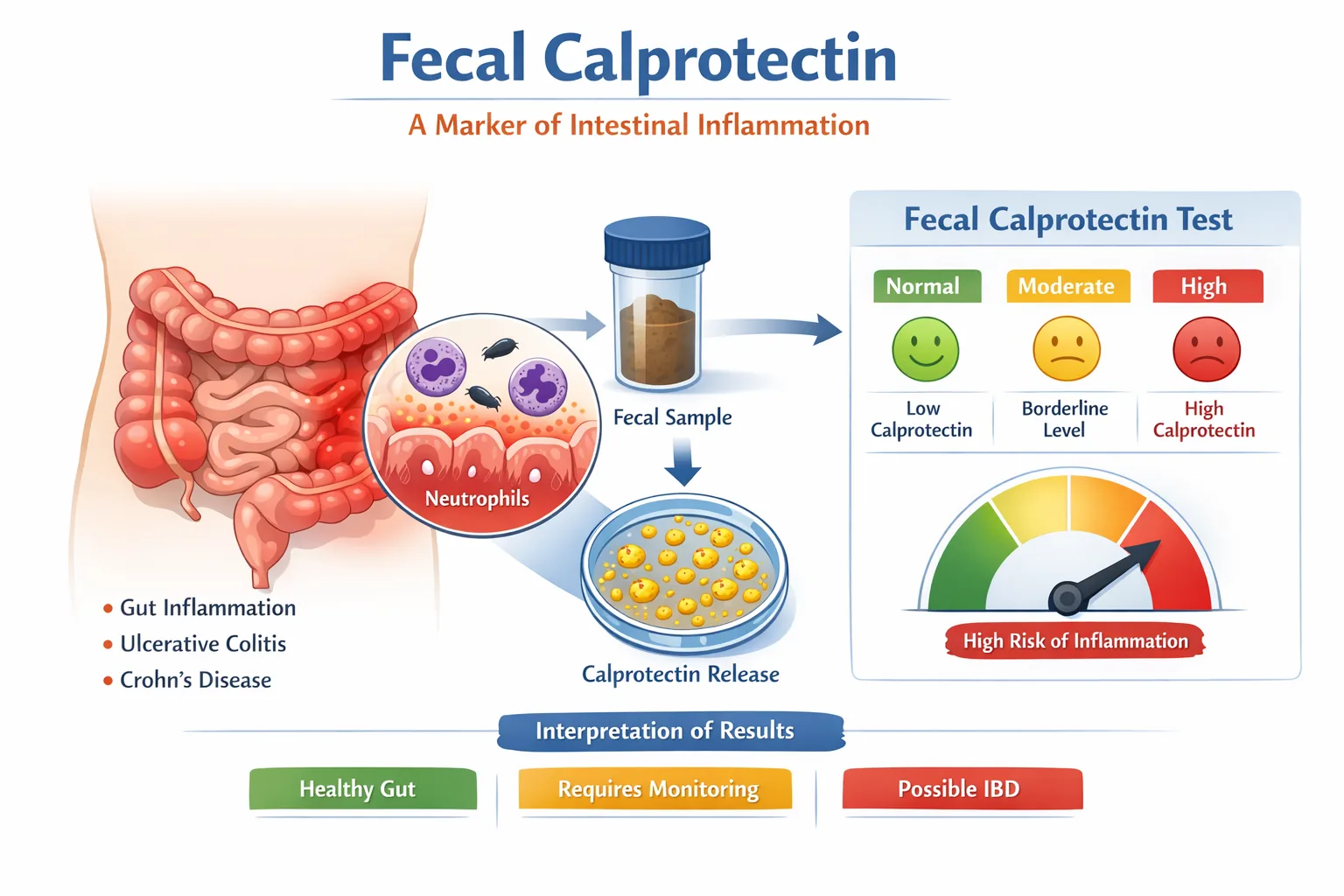
Every patient is tested at HanStep Korean Medicine Clinic before treating ulcerative colitis and Crohn's disease. Results such as blood test markers, fecal calprotectin (a stool inflammatory marker), and stool occult blood levels from the hospital are important.
Limitations of Blood Tests
- Test items: CRP, ESR
- Why is it insufficient?
- Generally, if inflammation occurs only in the lining of the large or small intestine, it is rare for inflammatory substances to pass through the intestinal wall and affect the blood. Therefore, even if there is significant inflammation on endoscopy, markers like CRP and ESR in blood tests are often normal. If inflammatory markers in blood tests are normal at the beginning, they often remain normal afterwards, so blood test inflammatory markers are not very important. In cases where blood test inflammatory markers are bad, we check if they become normal during treatment.
Importance of Stool Tests
- Test items: Fecal Calprotectin (FC), Stool Occult Blood (Stool OB)
- Key Indicators
- Since both ulcerative colitis and Crohn's disease are cases where inflammation has occurred in the intestine, checking stool inflammatory markers is important. Even in a remission state where there are no clinical symptoms, fecal calprotectin and occult blood levels are often positive. If the fecal calprotectin level is higher than the standard, it means there is inflammation; if the occult blood test is positive, it means there is bloody stool.
Final Goal of This Stage
Therefore, through complete treatment, we must ensure that both fecal calprotectin and occult blood levels become normal.
This is the second treatment goal, the normalization of inflammatory markers, and once this stage is reached, we allow the patient to reduce and stop the Western medications they were using if they wish.
Endoscopic Remission
Once the second stage is achieved and no Western medications are being used, we continue to observe the progress while taking only Korean herbal medicine for 3 months.
This period is for completely stabilizing symptoms. We confirm that symptoms do not recur after stopping Western medication and that they do not worsen due to other problems.
Stool inflammation tests are conducted every 4 weeks to verify complete stabilization.
Once it is confirmed that symptoms are stable for more than 3 months without using Western medication, we proceed with tests such as endoscopy and CT. We conclude the treatment after confirming through these tests that the treatment results are good.
Colonic Hypofunction Showing Special Treatment Progress
While five of the six causes that worsen ulcerative colitis and Crohn's disease (1-5) are diarrhea-type, the 6th type, colonic hypofunction, is constipation-type, so it shows a different treatment progress.
Dosage Adjustment and Treatment Process
If it is determined at the beginning of treatment to be colonic hypofunction, we administer medicine that stimulates colon movement. Since the degree of colonic hypofunction varies from patient to patient, the dosage of the Korean herbal medicine must be consistently adjusted. We start at a low concentration and gradually increase the dose of the herbal medicine while treating. Once the appropriate dosage is reached, bowel movements become easier, and bloody stools, diarrhea, abdominal pain, and bloating disappear.
Termination and Recurrence Prevention
In the case of colonic hypofunction, even after reaching the stage where clinical remission and inflammatory markers have normalized, one should not stop the herbal medicine easily, even after complete improvement. If herbal medicine is stopped immediately, constipation often reoccurs, and in such cases, it recurs after 10-12 months. Therefore, you must ensure that constipation does not occur even without taking herbal medicine; if you treat by gradually reducing the dose of the herbal medicine, you will eventually not have constipation even after stopping the herbal medicine, and if constipation does not occur, it will not recur. In the case of colonic hypofunction, the finishing period is often long because we must ensure that a tendency toward constipation does not occur even after complete remission.